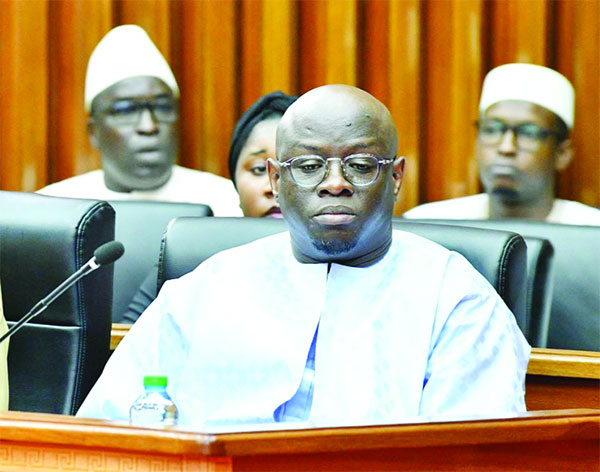
When it was least expected, after the reading of the Committee’s report and the procedural observations, the Minister of Finance, who must have good advisers, requested that the bill be referred back to committee under Article 84, so as to cut the general debate short.
The issue is neither the admissibility of the referral nor its consequences, but the limits that the Rules of Procedure place on the presiding officer in such circumstances. The only wise course open to him was to recall the provisions of Article 84 and inform the Assembly of the decision to refer the bill back. Full stop.
Referring the examination of a bill back to committee is an option open to MPs and to the government’s representative. In such a case, it is a matter of right and carries no other meaning in terms of any supposed dialogue.
What is at stake is respect for the principle of separation between the role of referee and that of participant in the parliamentary debate.
The Speaker of an Assembly may be a political leader, defend a partisan line and challenge the government’s positions. But when he presides over a sitting, he exercises a particular institutional function. He cannot invoke the authority of the Speaker’s chair to impose on the government’s representative a political rejoinder to which the latter cannot respond under the ordinary conditions of a debate between parliamentarians. It is not even courteous.
It is precisely this asymmetry that underpins the requirement of functional impartiality.
Indeed, Article 78 of Organic Law No. 2025-11 of 18 August 2025 provides: “The President may take the floor in a debate only to set out the state of the question and to bring the debate back to it. If he wishes to take part in the debate, he shall leave his chair and may resume it only once discussion of the matter concerned has been exhausted and concluded by a decision of the Assembly.”
This text is unambiguous: the functional impartiality of the presiding officer is not a mere parliamentary nicety. It is the subject of an express provision of the Rules of Procedure. Consequently, lecturing the minister on politics, rather than setting out the state of the question or bringing the debate back to it, amounts to conduct that manifestly violates Article 78 of the Rules of Procedure, and not merely a breach of a general principle of impartiality.
The Speaker of the National Assembly cannot simultaneously be the referee of the debate and one of its protagonists. He must choose: preside or debate. For the Speaker’s chair is not a political platform from which one may, with impunity, hurl invective, stir up controversy and settle political scores without running the risk of being contradicted.
Babacar GAYE
Former parliamentarian
Comments (0)
Be the first to comment.
Sign in to comment