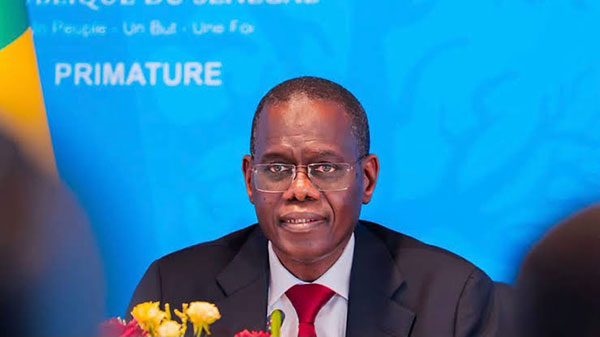
Faced with the rejection of the draft supplementary budget (LFR) by the National Assembly’s Finance Committee, Prime Minister Ahmadou Alhaminou Lô has gone on the offensive. During a lengthy explanatory session, he sharply criticised the approach of Pastef MPs, whom he accuses of “obstructing” the government’s work, while defending the objective necessity of this budget revision in the face of economic and energy constraints.
By Dieynaba KANE – After the rejection of the draft supplementary budget by the National Assembly’s Finance Committee, the Prime Minister held an explanatory session yesterday. For more than two hours, Ahmadou Alhaminou Lô sought to provide clarification, while criticising the approach of Pastef MPs. In his remarks, the PM stressed that there is “a profound difference between obstructing the government’s work and an amendment by the National Assembly”.
According to Mr Lô, “Article 82 of the Constitution gives MPs the prerogative of amendment”. However, he asks MPs who wish to exercise this prerogative to answer for it to their constituents, “subject to the limits set by paragraphs 2 and 3 of Article 82 of the Constitution”. The article states that “the President of the Republic, the Prime Minister and MPs have the right of amendment (…) Proposals and amendments made by MPs are not admissible where their adoption would result either in a reduction of public resources or in the creation or increase of a public charge, unless such proposals or amendments are accompanied by proposals for compensating revenue”. It adds: “However, no additional article or amendment to a finance bill may be proposed by the National Assembly unless it seeks to abolish or effectively reduce an expenditure, or to create a revenue.”
According to the PM, since this text is clear, “what we are seeing is obstruction”. “We ask those who rejected the LFR in committee to table amendments, and I hope that will be done. They must tell Senegalese people what they want corrected rather than sticking to generalities. Generalities amount to obstruction; drafting an amendment makes you responsible for the constitutionality of that amendment. In 2024, 2025 and 2026, the budget was drawn up under constraint. Why blame us for it today? Table your amendments, don’t punish the People,” he urged the majority in the National Assembly.
“A profound difference between obstruction and amendment”
Continuing his explanations, Ahmadou Alhaminou Lô pointed out that the LFR “is an objective necessity”. “We have faced three constraints: first, a downward revision of revenue by 340 billion; an increase in unavoidable expenditure of an additional 540 billion linked to energy subsidies, but also to the need to give more resources to the Defence and Security Forces. We also have an obligation to contain an already high deficit in a context of severe public deficit constraints,” he noted. For the PM, “faced with such a situation, a responsible government cannot indulge in petty politics”.
He stressed: “We have to keep all spending unchanged without compromising salaries, the essential missions of the State, security spending and priority social protection spending. We were left with a decisive choice: maintaining investments whose project preparation is behind schedule or lacks funding. The responsible thing is to partially or fully postpone these disbursements, which could in no way have been made before the end of the year. You persist in trying to make the population believe that you have 50 billion for the major water transfer that must be carried out, when the studies have not even been completed. That is our responsibility.”
The three major constraints that make the LFR necessary
According to Alhaminou Lô, the government did what it had to do by explaining matters to MPs in a 30-page document and giving them all the answers. Explaining the draft supplementary budget (Plfr), he maintained: “We have kept the commitment authorisations. What we have changed are the payment appropriations for the rest of the year. If the objective conditions for a disbursement are not met, it is better to allocate it to other expenditure, but the commitment authorisations remain. The Plfr provides for a 555 billion reduction in investment appropriations, but this is simply investment deferred to next year, because the conditions for using these appropriations have not been met, or there were other more urgent expenses, for which budget lines had to be made for a hospital, for roads, for water, for boreholes. But if it cannot be carried out, let us carry this appropriation over to next year so that other expenditure can be made.”
Continuing, the PM noted that it is clear “that there are essential issues this LFR seeks to resolve”. These include payment arrears of 300 billion. “But to enter these 300 billion, we had to look at the projects that are not working, take them out and create some room for manoeuvre. It should be remembered that there are 1,956 billion in payment arrears. Are these 300 billion going to wait when this affects the lives of thousands of Senegalese? Not voting for the LFR means preventing construction and public works companies from regaining cash flow; it means preventing technicians, workers and engineers from working and receiving their wages. Everyone will have to take responsibility,” he warned.
Payment arrears and deferred investment: the government’s choices
The PM, who is appealing for responsibility, believes it is necessary to “come back to reason and acknowledge that this LFR, contrary to what has been claimed and presented, corresponds to the initial finance law (Lfi) presented by PM Ousmane Sonko in the Council of Ministers, which went to Parliament and was voted by MPs in both revenue and expenditure”. “It is this draft budget that we are bringing back to you for a few corrections, which are largely explained by the rise in oil prices. We had budgeted for 69 dollars a barrel; we are now at more than 100 dollars. We had two options, notably passing everything on to the Senegalese population for the 500 billion. There would be no LFR for that line because we would not have increased subsidies. In the absence of a mechanism, having the State budget bear the burden is what we are presenting to Parliament. It is essentially because we did not make Senegalese people bear the oil shock. If we were not a government that looks at what Senegalese people can bear, we would not be talking about an LFR. We are not lazy; we are a talented team. We went and found these 540 billion from investments that were not going to be carried out,” Alhaminou Lô said in his defence. Regretting the attitude of the majority MPs, he believes one can “oppose but not peddle lies”. “It is pathetic on the part of representatives of the People,” he said.
Returning to some of the MPs’ questions, particularly the reduction of the State’s running costs, the PM revealed that 180 billion in operating expenditure had been cut (appropriations for supplies, consumables, conferences, seminars, celebrations and ceremonies have been sharply readjusted). “In many departments, we made cuts of 50 to 80% of available appropriations, excluding the social sectors. Only mandatory or particularly sensitive expenditure was preserved,” he said. What about the abolition or rationalisation of certain agencies? For the PM, there is no need to rush; the work will continue. And by the end of the year, the government will do what it has to do.
dkane@lequotidien.sn
Comments (0)
Be the first to comment.
Sign in to comment