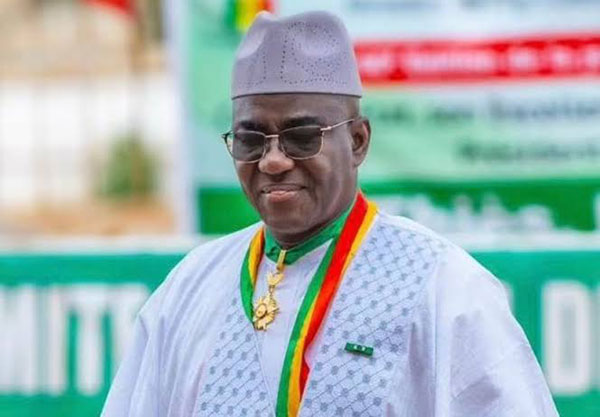
The horse racing CNG held its information General Assembly on Saturday at the Léopold Sédar Senghor Stadium. In the presence of the Director of Physical and Sporting Activities (Daps), Gilbert Sidy Lamine Mbengue, its president, Dr Bassirou Fall, welcomed the smooth running of the season, the first of his term, which began last January.
By Woury DIALLO – The National Horse Racing Management Committee (Cng-Ch) held its ordinary General Assembly on Saturday at the Léopold Sédar Senghor Stadium. It was a moment of sharing during which the new team presented its moral report, the review of the season’s activities (such as the 2025-2026 season), and the financial report submitted for approval to stakeholders in the sector and representatives of the Ministry of Sports.
“Our ambition is therefore not simply to look back at the past. Above all, it is to draw lessons from our collective experience in order to prepare a more solid, better organised and more promising future for Senegalese horse racing,” the CNG president said. Through prudent management, a major mobilisation of energies and a constant determination to maintain dialogue with stakeholders, Dr Fall’s team was able to organise the 25 race days scheduled in the 2026 season calendar, comprising 118 races. The season was marked by several major events, including the National Gendarmerie Grand Prix, the Grand Prix of the Ministry in charge of Agriculture, the Lonase Grand Prix and the Head of State’s Grand Prix, which closed the season on 9 August 2026 at the Ndiaw Macodou Diop racecourse in Thiès. In its review, the CNG also noted efforts made towards decentralisation, and coordination through twenty-six meetings and several hundred letters exchanged with administrations, partners, territorial authorities and the various parties involved. While the review was positive, reforms are needed for a better future for the equestrian world. On this front, stakeholders discussed major projects such as the structuring of stables, jockey training, strengthening fair play and modernising racing infrastructure, against the backdrop of plans for a multi-purpose national racecourse, among other things.
“We know, however, that progress is still needed. Certain shortcomings regarding infrastructure, equipment, the security of racing venues and the logistical preparation of race days have been identified. We must have the courage to acknowledge these difficulties in order to provide concrete answers to them,” Dr Fall said.
To achieve these objectives, the CNG president believes that “the development of Senegalese horse racing requires strong cooperation with public institutions, economic partners and foreign racing organisations”.
On this front, there is cooperation with Morocco, notably with Sorec, in training, experience-sharing and skills development, and relations with the Association sportive des courses de Toulouse, notably through the Senegal Grand Prix scheduled in Toulouse on 11 November 2026. The CNG also wishes to continue reflecting on the gradual evolution of the sporting model, the diversification of horse categories and the improvement of training and competition conditions.
On the financial side, in keeping with the demand for rigour and transparency, the CNG president explained that the report has not yet been finalised by the Treasurer General. It was therefore difficult to present an audited and validated report. A better way to “consolidate the confidence of the authorities, partners and all stakeholders in the sector”. In a message, the CNG president called on all components of the racing family, urging them to put the general interest first, favour dialogue and seek solutions to difficulties together.
wdiallo@lequotidien.sn
Comments (0)
Be the first to comment.
Sign in to comment